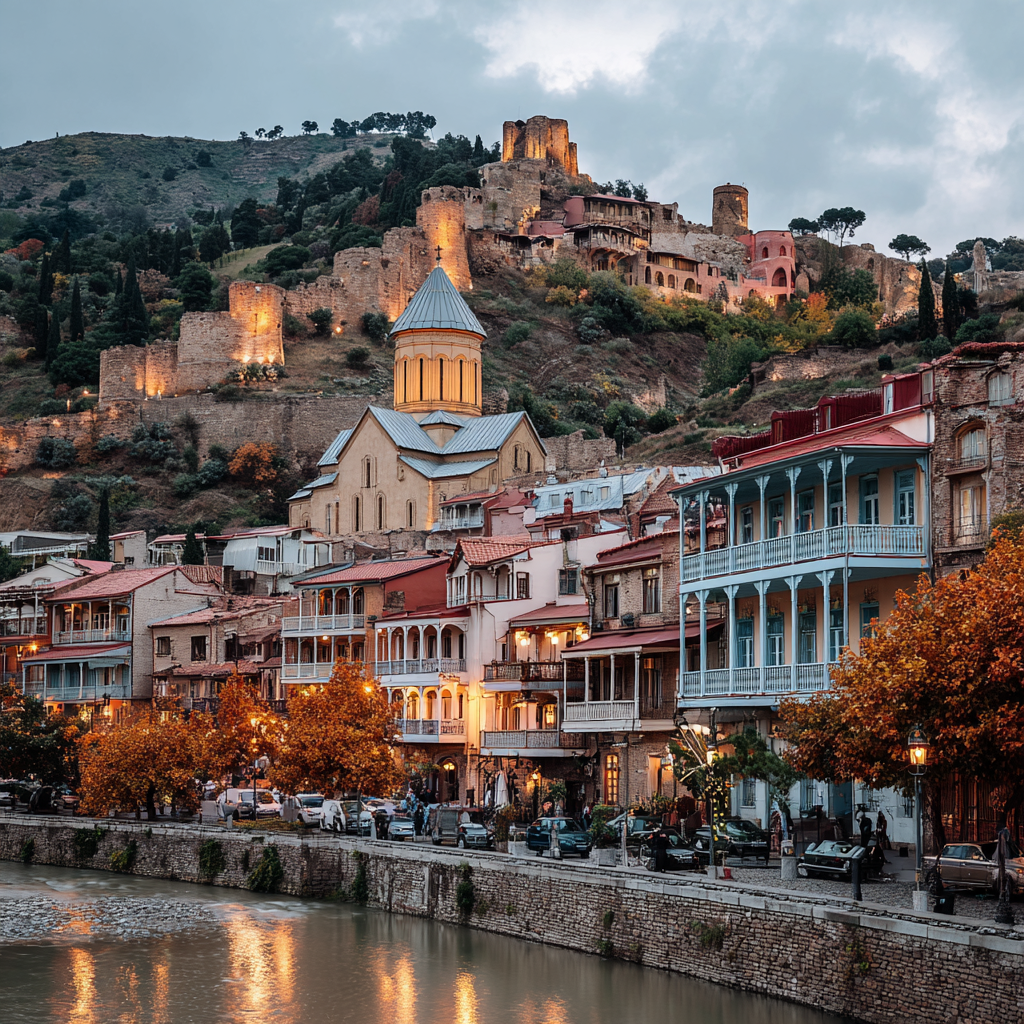
Old Town – Time Thick in the Air
Tbilisi’s Old Town is where most travelers start, and it’s easy to get lost. And you should get lost. Narrow alleys twist unpredictably, stairs rise then drop, and every corner hides something – a tiny shrine, a mural, a cat sleeping on a sun-warmed stone wall.
There’s the Sioni Cathedral, with golden domes and frescoes that look like they’ve been breathing centuries of prayer. Walking inside, the smell of incense is strong, the floor cold under your feet. You don’t just see history, you feel it in the bones.
Near the cathedral, the sulfur baths in Abanotubani steam constantly. The domes rise like soft mushrooms, pink and orange against the sky. Go in, soak in the hot water, and you feel centuries of relaxation rubbing off on you. Men and women bath separately, and sometimes you see locals chatting quietly, eyes half-closed, the heat making everyone a little softer.
Balconies, Rust, and Everyday Beauty
Tbilisi’s architecture is a mess in the best way. Rusty balconies hang precariously, wooden shutters barely hold onto paint, staircases twist like snakes. And somehow it all works. Someone told me it’s “controlled chaos,” and yeah, that feels right. Life happens here on the balconies. You watch women hanging laundry, men smoking cigars, kids chasing each other up and down stairs. The city moves slowly but unpredictably, like it has its own rhythm you’re only beginning to hear.
Street art peeks out everywhere, sometimes covering walls of crumbling buildings. Some murals are political, some just funny, some beautiful in a way that’s hard to describe. The city isn’t polished, it’s lived in, and that makes it feel alive.
Food – Bold, Honest, Full of Flavor
Georgian food is one of the best-kept secrets of the world. It’s hearty, rustic, and a little messy – exactly what you want after wandering hills all day.
Start with khachapuri, the cheese-filled bread that’s basically a national obsession. In Tbilisi, it comes in all forms, but the Adjarian version – boat-shaped, with melted cheese, butter, and a raw egg cracked on top – is a must. You’re supposed to mix the egg and butter with the cheese, tear pieces off, and eat while it’s steaming. It’s indulgent and perfect, and yes, a little ridiculous if you think about it.
Then there’s khinkali – giant dumplings filled with spiced meat and broth. You hold them by the twisted top, bite a small hole, slurp the soup inside, then eat the rest. It’s messy, fun, and everyone does it wrong the first time. Don’t worry, locals will just laugh and keep eating.
Georgians love to drink, too – and the wine scene is historic. Georgia is one of the oldest wine countries in the world. Step into a tiny wine bar in Old Town, and you’ll find clay qvevri wines that taste unlike anything you’ve had before. Locals pour generously, share stories, and maybe sing a little. Dinner is rarely quiet.
Modern Tbilisi – Cafes, Galleries, and Night Vibes
Beyond the Old Town, new districts are booming. Rustaveli Avenue stretches with theaters, cafes, shops, and some serious street art. The vibe is modern, creative, full of people on laptops, kids on scooters, couples taking selfies.
Fabrika, a former Soviet sewing factory turned multi-purpose space, is the perfect example. It’s part hostel, part cafe, part art gallery, part coworking hub. You can drink coffee, explore murals, shop local crafts, meet travelers from everywhere. It feels young, energetic, alive – like Tbilisi’s beating heart.
At night, the city changes again. Old Town glows under warm streetlights. Bars, small and tucked away, pulse with music. Bass from the clubs mixes with the river’s hum. People spill out onto streets, chatting, laughing, wandering between tiny eateries. It’s loud but not overwhelming, intimate but wide open.
Bridges, Hills, and Views Everywhere
One thing you quickly learn – Tbilisi is a city of views. Climb the steps to Narikala Fortress, a 4th-century citadel overlooking the city. From there, Old Town’s red roofs stretch toward the river, bridges glint in the sun, the hills rise behind. It’s the kind of panorama that makes you pause, take a deep breath, maybe sit for an hour just watching clouds move.
The Bridge of Peace – that modern, curvy pedestrian bridge over the Mtkvari – looks like something from the future. At night, LEDs pulse under your feet, reflecting on the water. Walk slowly, watch couples pose, and try not to feel like Tbilisi is playing with your sense of time.
Local Life – Cafes, Markets, and Daily Chaos
Tbilisi isn’t a museum, it’s a home. Walk into a local market – Dezerter Bazaar is the biggest – and you’ll see fruit piled high, walnuts, spices, khinkali dumplings sold by the kilo, homemade cheese. Vendors shout, bargain, joke, everything smells rich and earthy.
Coffee shops are everywhere, many tucked in residential streets. People sip espresso, read, talk loudly, smoke sometimes. There’s a kind of everyday rhythm that feels unpolished but real. You can sit for hours and watch life happen – kids skateboarding, old men playing chess, dogs roaming freely.
Culture, Music, and the Unexpected
Tbilisi is surprisingly artsy. Small theaters host experimental performances, galleries pop up in alleyways, and there’s always some kind of music spilling from a courtyard. Traditional Georgian polyphonic singing still survives in churches and special events. You hear it randomly, a trio of voices that sounds like it could crack the air.
Then there’s modern music – DJs, indie bands, jazz. You’ll find a small club, someone on the roof mixing tracks, people dancing under fairy lights. The mix of ancient and modern, sacred and playful, is everywhere.
Even festivals are a blend of old and new – Tbilisi Open Air, Art-Gene Folk Festival – people dancing in fields, kids running, drinks in hand. It’s colorful, loud, joyful, alive.
Hills, Hot Springs, and Hidden Corners
Vake and Mtatsminda are two districts worth wandering. You’ll find steep streets, quiet parks, and coffee with views. Mtatsminda has a funicular that takes you up to a hill with amusement rides and a giant view of the city.
Sulfur baths in Abanotubani deserve another mention – they’re not just for tourists. Locals come to soak, chat, relax. There’s a warmth, a sense of ritual, a pause from the constant hum of the city below.
Walk small streets away from tourist paths and you’ll see neighborhoods that feel unchanged for decades – peeling paint, kids playing, old men gossiping on benches. It’s beautiful in its own lived-in way.
Tbilisi in Motion – Old Meets New
What strikes most travelers is the city’s contradictions. Old houses crumble next to neon bars. Churches sit beside graffiti. Cobblestones meet modern glass buildings. It feels messy but intentional. And somehow, it works. You don’t get lost because the city is chaotic – you get lost because you want to.
You learn patience here, but also spontaneity. One block might have a centuries-old church, the next a DJ pumping electronic beats. You wander, get distracted, stumble into something amazing. That’s Tbilisi.
Leaving Tbilisi, But Not Really
When you leave, you realize you’ve taken more than photos. You’ve absorbed the sound, the smell, the rhythm. Tbilisi stays with you – the clinking of glasses, the steam from sulfur baths, the laughter echoing down alleyways.
It’s not a city you conquer, it’s one you live with for a while. You think you’re passing through, but in a way, it passes through you.
Tbilisi is alive, messy, real, and stubbornly beautiful. And like the best cities, it teaches you to slow down, pay attention, and notice the small things – the tiny balconies, the cracked tiles, the way sunlight hits a dome in the late afternoon.